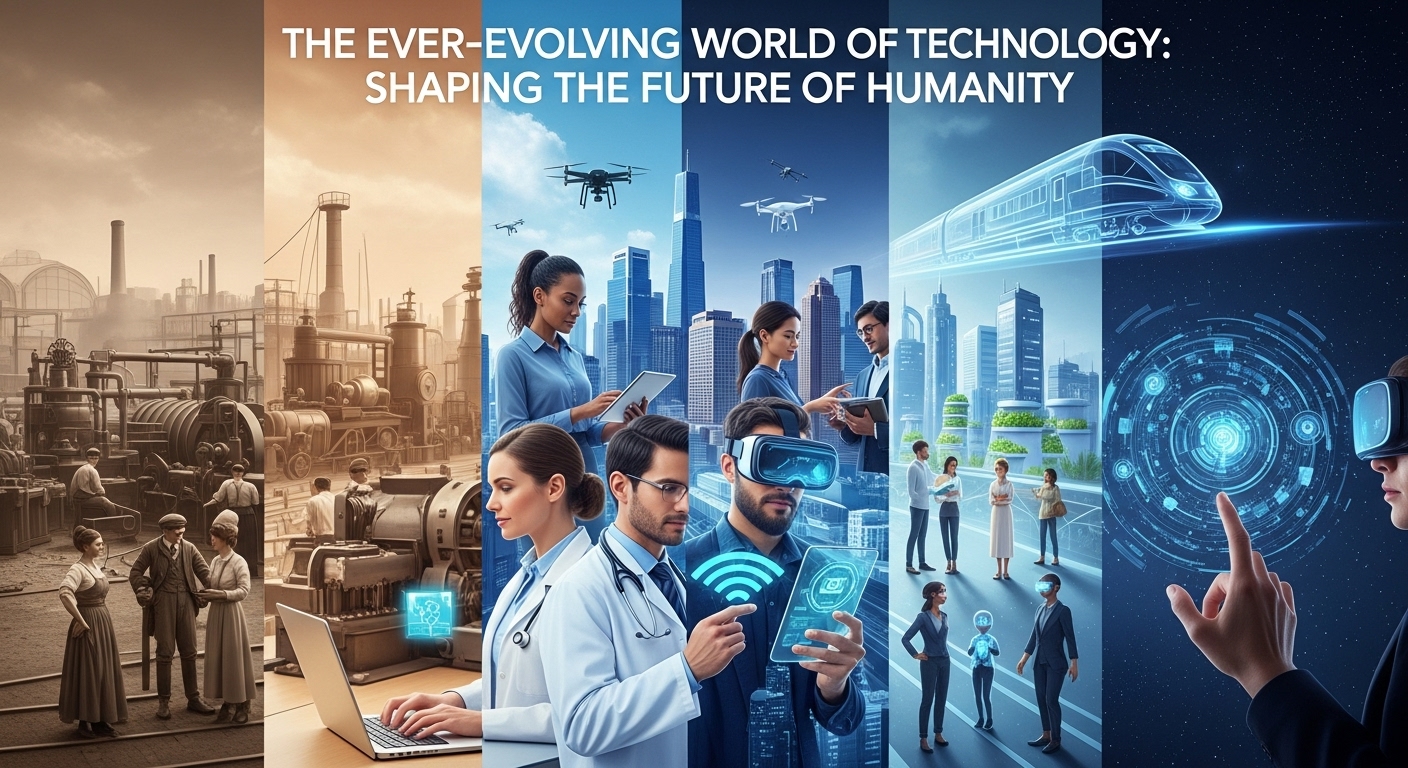
Technology has always been an integral part of human civilization. From the first stone tools created by our ancestors to the advanced artificial intelligence shaping our world today, innovation has continuously redefined how we live, communicate, and understand our universe. The story of technology is, in essence, the story of human progress — a narrative driven by curiosity, necessity, and imagination.
In the twenty-first century, technology is not merely a tool; it is the environment we live in. It influences our relationships, economies, education, and even our sense of identity. To truly appreciate the world we inhabit today, it’s worth tracing how technology evolved, how it impacts our daily existence, and what the future might hold as we stand at the intersection of human ingenuity and digital transformation.
The Dawn of Technological Thought
Before electricity, before machines, before the internet, humanity’s earliest technologies were born out of survival. The discovery of fire and the creation of tools made from stone and bone marked the first technological revolution. Fire provided warmth and protection, while tools enhanced hunting and building capabilities. These innovations laid the foundation for civilization itself.
As human societies evolved, so did their tools. The invention of the wheel around 3500 BCE revolutionized transportation and trade. The development of writing systems allowed humans to record information, pass on knowledge, and build organized societies. Each invention acted as a stepping stone, enabling the next wave of progress.
Technology was not just about gadgets or machinery; it was about problem-solving. The agricultural revolution, for example, allowed humans to cultivate crops and domesticate animals, leading to the establishment of permanent settlements. This shift changed the course of history by creating surplus food, which in turn gave rise to cities, governance, and culture.
The Mechanical Age and the Birth of Engineering
The mechanical age began with the advent of simple machines — pulleys, levers, and gears — that helped humans perform tasks more efficiently. Ancient civilizations like the Greeks, Romans, and Egyptians applied these technologies in remarkable ways. The pyramids, aqueducts, and catapults stand as testaments to the ingenuity of ancient engineers.
The Middle Ages saw the rise of more complex mechanical inventions, including clocks and printing presses. Johannes Gutenberg’s printing press, created in the 15th century, changed the world by democratizing knowledge. Books became accessible to more people, accelerating education and scientific discovery.
By the 17th and 18th centuries, mechanical engineering evolved further with the invention of steam engines. This marked the beginning of the Industrial Revolution — a transformative era that changed economies, societies, and ways of life across the globe.
The Industrial Revolution: A Turning Point for Humanity
The Industrial Revolution was more than just a period of technological advancement; it was a social, economic, and cultural transformation. Steam engines powered factories, trains, and ships, connecting cities and nations. Industries like textiles, mining, and manufacturing grew at unprecedented rates.
Urbanization followed rapidly. People migrated from rural areas to cities in search of work, leading to the creation of new social classes and lifestyles. The world was suddenly faster, more connected, and more productive.
However, this progress came with challenges. Labor exploitation, environmental degradation, and social inequality emerged as significant issues. Yet even with its flaws, the Industrial Revolution set the foundation for modern technology by introducing mass production, mechanical efficiency, and industrial innovation.
By the late 19th century, electricity became a driving force of progress. The work of inventors such as Thomas Edison, Nikola Tesla, and Alexander Graham Bell introduced new technologies that reshaped communication, energy, and entertainment. The light bulb illuminated homes and streets, while the telephone connected voices across continents. Humanity was entering the electric age — an era defined by invention and imagination.
The Information Age: The Birth of Digital Technology
The 20th century brought about the greatest technological transformation in human history — the digital revolution. The invention of the computer redefined the meaning of information. Machines that could calculate, process, and store data opened doors to possibilities once confined to science fiction.
Early computers were massive and expensive, used mainly for military and scientific purposes. However, the development of transistors, microchips, and semiconductors led to the creation of smaller, more affordable machines. By the 1980s, personal computers entered homes, offices, and schools, changing how people worked, learned, and communicated.
The next leap came with the rise of the internet. What began as a government research project evolved into a global network connecting billions of people. Information that once took days or weeks to transmit could now travel instantly. Communication became instantaneous through emails, chats, and video calls. The world had become a digital village.
This era also gave rise to new industries — software, telecommunications, and digital media — that redefined economies and job markets. Companies like Microsoft and Apple transformed computing into an everyday experience, while search engines and online platforms reshaped how we access and consume information.
The Mobile Revolution: Technology in Our Pockets
If the computer brought technology into homes, the smartphone brought it into our hands. The mobile revolution began in the early 2000s with the introduction of cell phones capable of more than just calls. As wireless networks improved, phones evolved into multifunctional devices — combining cameras, internet browsers, and entertainment centers.
The release of smartphones changed the dynamics of human interaction. Suddenly, the entire world could be accessed through a screen that fit in your pocket. Social media platforms emerged, creating new forms of communication and expression. People could share moments instantly, connect across continents, and participate in global conversations.
Mobile technology also transformed industries. Banking, education, and healthcare integrated apps to reach users conveniently. E-commerce thrived as people began shopping through mobile platforms. Navigation systems changed travel, while mobile photography redefined art and media.
The smartphone symbolized a new age of connectivity and independence, but it also brought challenges such as information overload, privacy concerns, and digital addiction. Despite these drawbacks, mobile technology remains one of the most influential advancements of the 21st century.
Artificial Intelligence and Machine Learning: The Age of Smart Technology
Today, we live in the age of artificial intelligence. Unlike past innovations that merely extended human capability, AI mimics human thinking and decision-making. From recommendation algorithms to autonomous vehicles, AI systems analyze data, recognize patterns, and make predictions faster than any human could.
Machine learning — a subset of AI — enables systems to learn and improve from experience. This technology powers everything from virtual assistants to fraud detection systems. AI has become integral in industries such as healthcare, finance, transportation, and entertainment.
For example, in healthcare, AI assists in diagnosing diseases with higher accuracy and speed. In finance, algorithms analyze market trends to make investment decisions. In entertainment, recommendation systems suggest movies, music, and content tailored to individual preferences.
AI is also reshaping creativity. Tools that generate art, music, and literature challenge traditional definitions of human expression. The line between man and machine continues to blur, raising ethical and philosophical questions about the future of intelligence, autonomy, and creativity.
The Internet of Things: A Connected World
As technology advances, the concept of connectivity extends beyond humans and computers. The Internet of Things, or IoT, connects everyday devices — refrigerators, cars, lights, and even clothing — to the internet. These devices collect and exchange data to improve convenience, efficiency, and safety.
Smart homes are now equipped with devices that control lighting, temperature, and security through voice commands. In cities, IoT systems monitor traffic, manage waste, and optimize energy consumption. Agriculture benefits from smart sensors that track soil moisture and weather conditions to increase crop yields.
IoT represents a world where information flows continuously between people and machines. It promises greater automation and personalization but also poses concerns regarding data privacy and cybersecurity. As everything becomes interconnected, safeguarding digital systems becomes essential to prevent misuse and breaches.
The Role of Cloud Computing in Modern Technology
Cloud computing revolutionized the way data is stored, shared, and processed. Instead of relying on local hardware, individuals and businesses can now access vast amounts of data through remote servers. This innovation enables flexibility, scalability, and collaboration on an unprecedented level.
Companies use cloud platforms to manage operations, store data, and deploy software globally. For individuals, cloud services provide access to files and applications from any device, anywhere. This shift has fueled the rise of remote work, online education, and digital collaboration.
Moreover, cloud computing has democratized technology. Startups and small businesses now have access to powerful computing resources without the need for expensive infrastructure. This accessibility accelerates innovation, allowing new ideas to grow faster and reach wider audiences.
Cybersecurity: Protecting the Digital Frontier
With great connectivity comes great vulnerability. As digital systems expand, so do the risks associated with cyberattacks, data breaches, and identity theft. Cybersecurity has become one of the most critical aspects of modern technology.
Governments, corporations, and individuals invest heavily in securing networks and information. Encryption, authentication, and advanced monitoring systems protect data integrity. However, cyber threats continue to evolve, requiring constant adaptation.
The importance of cybersecurity extends beyond personal safety. National infrastructure, banking systems, and even democratic processes rely on secure digital networks. Protecting these systems is not just a technical challenge but a moral and political responsibility.
The Rise of Automation and Robotics
Automation has changed how industries operate. Robots and automated systems handle tasks that are repetitive, dangerous, or require high precision. In manufacturing, automation increases efficiency and reduces human error. In healthcare, robotic surgery enhances accuracy and minimizes recovery time.
Autonomous vehicles are one of the most promising examples of robotics in action. Cars capable of self-driving use sensors and AI to navigate roads safely. While still under development, such technology has the potential to reduce accidents and revolutionize transportation.
Yet automation also raises social and economic concerns. As machines replace human labor, questions arise about employment, income inequality, and the future of work. Balancing technological advancement with human welfare remains a complex challenge for society.
Virtual Reality and Augmented Reality: Expanding Human Experience
Virtual reality (VR) and augmented reality (AR) push the boundaries of perception. VR immerses users in computer-generated worlds, while AR overlays digital elements onto the real environment. Together, they are transforming entertainment, education, and design.
In gaming, VR creates fully interactive environments where users can experience alternate realities. In education, AR allows students to visualize complex concepts through interactive 3D models. Architects and designers use these technologies to simulate structures before construction, saving time and resources.
The potential of VR and AR extends to healthcare as well. Therapists use VR for exposure therapy, while surgeons practice procedures in simulated environments. As hardware improves and costs decrease, these technologies are expected to become part of everyday life, enriching how we learn, work, and play.
Sustainability and Green Technology
As humanity faces climate change and environmental degradation, technology plays a crucial role in creating sustainable solutions. Renewable energy technologies such as solar, wind, and hydro power are reducing dependence on fossil fuels. Advances in battery storage and electric vehicles are making clean energy more practical and widespread.
Green technology extends beyond energy. Smart grids, sustainable agriculture, and waste management systems use data to optimize resource consumption. Eco-friendly materials and recycling innovations help reduce pollution and preserve natural resources.
However, technology alone cannot solve environmental challenges. It must be guided by responsible policies, ethical considerations, and collective action. The future of the planet depends not just on what we invent but how we choose to use those inventions.
The Future: Where Is Technology Taking Us?
Predicting the future of technology is difficult, yet certain trends point toward a world of deeper integration between humans and machines. Advancements in biotechnology, quantum computing, and artificial intelligence could redefine the limits of knowledge and capability.
Quantum computers promise to solve problems that traditional computers cannot handle, revolutionizing cryptography, medicine, and materials science. Biotechnology may enable humans to repair or even enhance their bodies. Brain-computer interfaces could blur the line between biological and digital intelligence.
At the same time, ethical questions will intensify. Who controls technology? How do we protect privacy and freedom in a world dominated by data? Can we ensure that innovation serves humanity rather than divides it? These questions will shape the next chapter of technological evolution.
Conclusion: Humanity and Technology — A Shared Destiny
The evolution of technology is the story of human ambition, creativity, and resilience. Each generation builds upon the innovations of the past, crafting tools that redefine what it means to live and think. From fire to artificial intelligence, technology has always been both a reflection and a driver of human progress.
Today, technology connects the entire planet, breaking barriers of time, language, and distance. It gives voice to the unheard, power to the powerless, and knowledge to the curious. Yet it also challenges us to remain ethical, responsible, and compassionate as we navigate a future of infinite possibilities.
The relationship between humanity and technology is not one of dominance but partnership. As we continue to innovate, our greatest task will be to ensure that technology serves the collective good — enhancing life, preserving the planet, and inspiring generations to come.
In the end, technology is not merely about machines or code. It is about us — the dreamers, the thinkers, and the creators who dare to imagine a better world.